Alright, let’s dive in. Japanese Garden Water Basin

I get this question all the time from rooftop gardeners: “Can I actually use a Japanese garden water basin up here?” And honestly, it’s not just a yes/no thing—there’s a lot that goes into making it work, especially since I’m the guy (well, one of the guys) that sells these basins. Let me start with the basics: Japanese garden water basins (we call them tsukubai, for the most part) aren’t just pretty decor. They’re functional, and that function translates weirdly well to rooftops—if you do it right.
First, let’s break down what a tsukubai is, for anyone who might be new. Traditional ones are usually made of stone—granite, sometimes basalt, even old river rocks that have been carved over decades. They’re meant to hold water for handwashing, a quiet, meditative ritual before entering a tea garden or a home. But on a rooftop? That ritual part is still there, but you’ve got to deal with rooftop-specific stuff: weight limits, wind, drainage, how much sun the basin’s gonna get.
Let’s start with the big one: weight. Rooftops can only hold so much extra weight, right? A lot of people panic about this, so let’s crunch some rough numbers. A standard tsukubai (18 inches across, 12 inches deep) made of solid granite weighs roughly 150 pounds empty. Fill it with water? That’s another 100 to 120 pounds (since water’s 8.3 pounds per gallon). Add the weight of the stone pad or base you’re gonna set it on—say another 50 to 75 pounds—and that’s a total of like 300 to 350 pounds. Wait, that’s totally manageable for most residential rooftops, right? A lot of city apartments have rooftops rated for way more than that, especially if it’s a newer building. The only time I’d flag a red flag is if someone’s got a super old building (pre-1970s, maybe) that never had its load capacity checked. Then you just gotta run it by the building manager or a structural engineer—no biggie. I always tell customers who ask about weight to grab a tape measure and their building specs; that’s the first step, not overthinking it.
Next up: wind. Rooftops are windy, duh. You don’t want a 150-pound stone basin tipping over and becoming a hazard. So, how do we fix that? Most of our basins come with a slight lip or a flat, wider bottom that helps with stability, but I always recommend anchoring it a little if it’s a high-wind area. Not drilling into the rooftop itself (unless your lease allows that—most residential buildings hate drilling into the deck), but using heavy, non-slip pads under the base, or even filling the base’s bottom with a little sand to weigh it down a touch. Wait, also—water level matters. If you fill it all the way to the top, that’s more surface area for wind to push on, so keeping it an inch or two below the rim cuts down on that. I had a customer in Brooklyn last year who thought her rooftop was too windy, so we paired her tsukubai with a low bamboo fence around it—did the trick, and it still looked like a real Japanese garden, not just a safety hack.
Drainage is another big one, and this is where a lot of people mess up. Traditional tsukubai have a small hole at the bottom, right? That’s for when you dump the water after use. But on a rooftop, standing water is a no-no. It can seep through the roof over time, cause leaks, or turn into a mosquito breeding ground. Here’s the thing: you don’t have to plug that drainage hole, but you do have to handle it properly. I tell customers to attach a small, flexible hose to the drainage hole and run it to a rooftop drain—easy peasy. Or, if you don’t want to drill holes, set the basin on a bed of small river rocks or a shallow tray that lets excess water drain away, not pool. Also, the sun on a rooftop is way stronger than ground level, so water evaporates faster. That means you don’t have to top it off every day, but you do have to check it every few days, especially in the middle of summer. No one wants a dry, sad tsukubai up there.
Then there’s the vibe. This is the fun part. A lot of people think a rooftop is all concrete and fire pits, but a tsukubai changes that immediately. You can add a bamboo water spout—shishi odoshi, that little bamboo stick that makes a noise when it fills and tips. Wait, shishi odoshi is perfect for rooftops because it’s not too big, and that gentle clink is way quieter than, like, a lawnmower, so your neighbors won’t complain. I had a customer in Chicago who paired his tsukubai with a few potted Japanese maples and some moss (he used a rooftop-friendly moss that doesn’t need a lot of water) and said his rooftop went from “another concrete box” to “my favorite spot in the whole city.” Even if you don’t go all out—just the basin and a small spout—it’s still that meditative touch that makes a rooftop garden feel intentional, not just a place to put a grill.
Wait, but what about materials? I mentioned granite, but we also sell basins made of cast stone, which is lighter. Oh right! That’s a game-changer for people with super old rooftops or smaller spaces. Cast stone tsukubai are 50-60% lighter than solid granite—so empty they’re like 80 pounds, full water is 180, plus base is another 40, total like 220. That’s even easier for load limits. And cast stone is weather-resistant, same as granite—doesn’t crack in cold, doesn’t fade in sun. I get so many customers who say they thought they couldn’t have a basin because of weight, then switch to cast stone and bam—problem solved. Also, we do a lot of custom stuff, too. If someone wants a basin that fits a tiny rooftop nook, we can make it shorter, or narrower. No reason to force a big, bulky basin on a space that’s only 3×5 feet.
Now, let’s talk about mistakes people make. Number one: buying a basin that’s too big for the space. I can’t tell you how many times someone comes to us with a picture of their rooftop and says “I want a tsukubai” then picks something that’s like 3 feet across, and their whole rooftop is 6 feet wide. It just looks off. Rooftops are about scale, so measure first, then pick a basin that’s 1/3 to 1/4 the size of the open garden space. Number two: not thinking about drainage. I had a guy in LA a few years ago who plugged the drainage hole to stop water from leaking, then came back a month later with a mosquito problem. We fixed it by adding a small drainage tray under the basin, and he hasn’t had an issue since. Number three: forgetting about the local climate. If you’re in a place that gets super cold (like Minnesota), you have to drain the basin in winter—water expanding when it freezes can crack the stone. That’s a quick fix, just drain it and cover it with a tarp or store it in a shed over the winter. No big deal, but something to plan for.
Wait, also—practical use. A lot of people ask, “Do I actually use it for handwashing?” Yeah, you can! The ritual of it is part of the fun. Rooftop gardeners often use it before they plant or trim, or just to splash a little water on their hands when it’s hot out. But if you don’t want to use it for that, you can just keep it as a water feature—add a small pump to recirculate the water, so it’s always moving, which keeps mosquitoes away. We sell those little submersible pumps that are made for small basins, super quiet, easy to install. No one wants stagnant water, so recirculating is a good hack if you’re not using it for handwashing.
Now, let’s get real—this isn’t just a trend. Rooftop gardens are huge right now, especially in cities where outdoor space is at a premium. A Japanese water basin adds something that a concrete planter or a plastic water feature can’t: that quiet, grounded feel. It’s not loud, it doesn’t take up a ton of space, and it works with pretty much any rooftop setup, as long as you plan ahead.
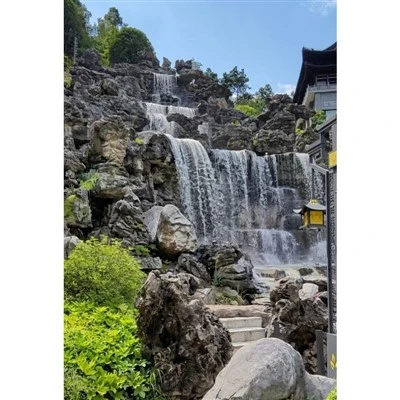
Let me wrap this up. So, can you use a Japanese garden water basin on a rooftop? Hell yes. You just have to do your homework: check the load capacity of your building, pick a basin size that fits your space, handle drainage properly, anchor it a little if you’re in a windy area, and think about the climate. And if you mess up? We’re here to help. Whether you need a weight calculator, advice on drainage, or a custom basin that fits your tiny rooftop nook, we’ve got your back. No question is too small—we’ve worked with everyone from first-time rooftop gardeners to building managers with 10,000 square feet of rooftop space to fill. If you’re ready to turn your concrete rooftop into your own little slice of Japanese garden, hit us up to chat through the details. We’ll make it work, no weird hoops to jump through.
Black Landscaping Stones References:
- Japanese Garden Society of America. Traditional Tsukubai: Design and Function, 2021.
- National Roofing Contractors Association. Rooftop Load Capacity Guidelines for Residential Structures, 2019.
- University of California Agriculture and Natural Resources. Rooftop Garden Water Management Best Practices, 2022.
- Architectural Concrete Council. Lightweight Cast Stone for Outdoor Architectural Features, 2020.
- Centers for Disease Control and Prevention. Mosquito Habitat Reduction for Outdoor Water Features, 2023.
Orin International Trade Co., Ltd.
With abundant experience, we are one of the most professional japanese garden water basin manufacturers and suppliers in China. We warmly welcome you to wholesale custom made japanese garden water basin from our factory. If you have any enquiry about cooperation, please feel free to email us.
Address: No.3-1, Shangzhongdi Natural Village, Hexian Village, Shuangta Sub-district, Jiangshan City, Quzhou City, Zhejiang Province
E-mail: atlas@orinstone.com
WebSite: https://www.orinstone.com/
